A coaster is one of the few branded items a customer will use without being asked. It sits under every cold beer, flat white, cocktail or water glass, protecting the table while keeping your logo, message or event detail in clear view. Done well, coaster printing turns a practical hospitality essential into consistent brand exposure.
For venues, clubs and businesses, that exposure is not a one-off glance. A coaster stays on the table throughout the visit, often appears in photos, and reinforces the standard of the space. For weddings, launches and private celebrations, it can tie styling together while giving guests something useful to take home.
Why coaster printing remains a smart promotional choice
Promotional products need to earn their place. A branded pen can disappear into a drawer. A flyer may be read once, if at all. Drink coasters have an immediate job to do, which is why they work across cafes, pubs, hotels, restaurants, offices, trade events and home entertaining.
The strongest custom coasters balance three things: a material suited to the setting, a design that reads clearly at coaster size, and print that holds up to real use. Getting any one of these wrong can reduce the impact. A premium logo printed on a material that does not suit a busy bar, for example, may not deliver the finish or lifespan expected.
That is also why the cheapest option is not always the best value. Cardboard coasters may be ideal for a high-volume promotion, a festival or a single event. Reusable rubber, cork, metal or acrylic coasters can make more sense where durability, presentation and longer-term visibility matter.
Choose the material before choosing the print
The right coaster begins with how and where it will be used. There is no single best material for every campaign.
Cardboard and pulpboard coasters are familiar in hospitality for good reason. They are absorbent, lightweight and economical at larger quantities. They suit beer gardens, bars, product launches and events where coasters may be replaced regularly. Their print area also gives businesses room for a logo, offer, QR code or campaign message, provided the artwork is not overcrowded.
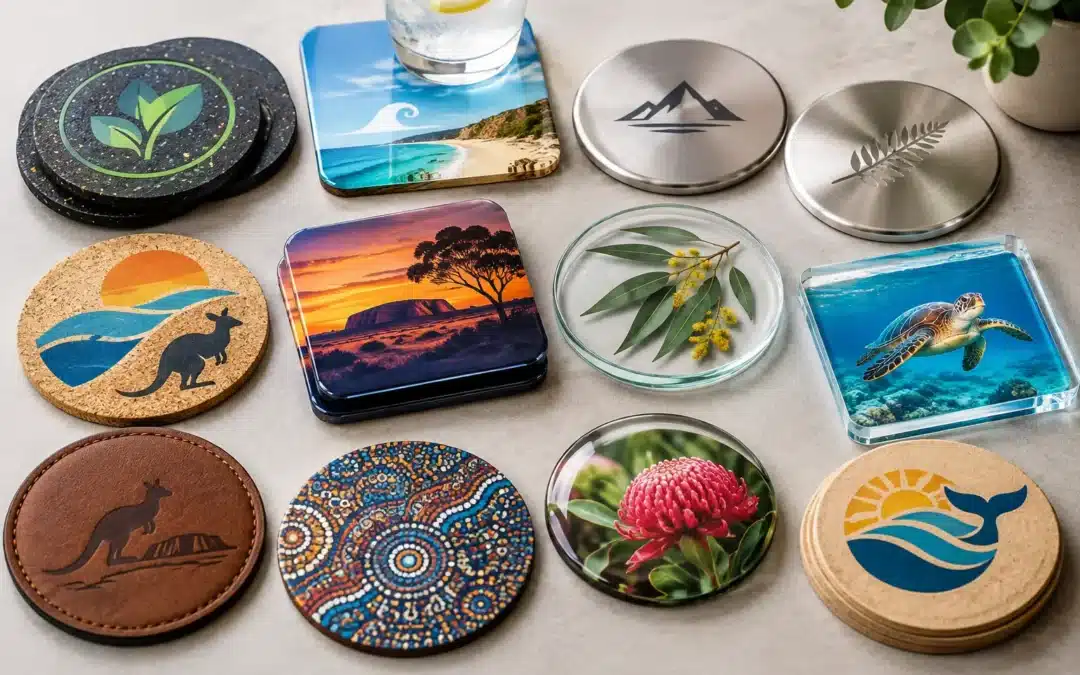
Recycled tyre rubber coasters offer a tougher, more distinctive alternative. Their non-slip feel and hard-wearing nature suit venues, breweries, automotive businesses and brands looking for a product with an environmental story. The recycled finish has character, so simple, high-contrast artwork generally performs best.
Cork, bamboo and leather bring warmth to a table setting. These materials work well for cellar doors, boutique accommodation, corporate gifts and businesses with a natural or premium brand position. Depending on the product and decoration method, a restrained logo, debossed mark or single-colour design can look more considered than a full, busy graphic.
Acrylic, glass, aluminium and stainless steel coasters create a cleaner, contemporary look. They are popular for executive gifting, restaurants, boardrooms and modern event styling. They can be highly reusable, but need careful artwork planning. Fine type, pale colours and overly detailed images may not reproduce as strongly as they do on a computer screen.
PVC rubber, resin and LED styles are better suited to brands that want something more unusual. They can add shape, texture, colour and novelty, particularly for entertainment venues, beverage promotions or activations. The trade-off is that specialised products can involve longer production requirements, so they are best planned well ahead of the event date.
Coaster printing needs artwork made for the surface
A coaster has limited real estate. That is not a disadvantage, but it does demand discipline. The most effective designs communicate quickly from across a table.
Start with the primary message. For most businesses, this will be a logo, business name or recognisable visual mark. If you are promoting an event, it may be the event name and date. If there is a call to action, keep it short and make sure it supports the main branding rather than competes with it.
Small text is one of the most common artwork issues. Contact details, disclaimers and lengthy social handles can become difficult to read once printed. A clean logo with a website or short campaign line is often more useful than trying to fit every detail onto one side.
Colour choice matters too. Strong contrast between the artwork and coaster material improves legibility, especially in dimly lit bars and busy function spaces. Consider where the coaster will be seen: a dark pub table, a bright cafe, an outdoor marquee or a formal dining room. Colours that look subtle on screen can disappear under low lighting or against a textured surface.
Where possible, supply quality vector artwork such as AI, EPS or print-ready PDF files. High-resolution files can also work for photographic designs, but low-resolution logos copied from emails or social media usually cannot be sharpened successfully. A free digital proof is valuable because it lets you check scale, placement, spelling and colour direction before production begins.
Match the coaster to the occasion
A venue ordering ongoing stock has different priorities from an organiser planning a one-night function. The best result comes from being clear about the intended use from the beginning.
For hospitality venues, durability and reorder consistency are usually key. A pub might choose absorbent cardboard coasters for day-to-day service, while a cocktail bar may prefer reusable rubber or premium acrylic styles that support its interior presentation. If a campaign changes seasonally, a lower-cost coaster can allow fresh messages without leaving unused stock behind.
For corporate events, branded coasters can make tables look organised without feeling overly promotional. They work particularly well at conferences, client functions and staff celebrations, where every drink station becomes a subtle branded touchpoint. Consider printing an event theme, sponsor recognition or a simple conversation starter on the reverse side.
For weddings and private parties, personalised coasters can carry names, a date, a monogram or a meaningful illustration. Materials such as cork, bamboo, acrylic and resin can suit a keepsake approach. Cardboard is often the practical choice where guest numbers are high and the coasters are primarily part of the table styling.
For retail promotions and product launches, think about what happens after the event. A reusable coaster may continue to sit in a customer’s home or office, extending the life of the campaign. A short-lived event coaster may deliver better value through broad distribution and a bolder, time-sensitive message.
Plan quantities, turnaround and budget early
Coaster printing is straightforward when the brief is clear, but custom production still needs enough time for artwork approval and manufacture. Leaving the order until the final week can restrict material choices or make it harder to achieve the finish you want.
Start with the event date or required delivery date, then work backwards. Allow time to finalise artwork, review the digital proof and make any adjustments. If coasters are being used at a major event, it is sensible to order enough for service, replacements and any extra tables that may be added later.
Quantity affects unit cost, particularly for printed cardboard styles and custom-shaped products. However, ordering far more than you can store or use is not automatically economical. A business with changing campaigns may prefer smaller, more frequent runs. A venue with stable branding may benefit from a larger order of its core design.
Be upfront about the budget as well as the desired look. An experienced supplier can recommend options that fit the brief rather than forcing a premium material into a price point where it will not make commercial sense. Drink Coaster provides tailored advice, material choice and free digital proofs to help customers make those decisions before production starts.
Small details that make custom coasters look professional
Shape, edge finish and print placement influence the final impression more than many buyers expect. Round coasters remain versatile, while square, rounded-square and custom-shaped styles can help a brand stand apart. A custom shape should still be practical enough to support common drinkware and stack neatly for staff.
Think about both sides of the coaster. A single-sided design may be all that is needed for a clean logo application. Double-sided printing can add a campaign message, menu prompt, event detail or different sponsor acknowledgement, but it should have a clear purpose. More print is only better when it makes the coaster more useful.
Finally, request a proof and assess it as a customer would. Can the logo be recognised at a glance? Is the type readable? Does the design suit the material? A few minutes spent reviewing these details can prevent a costly compromise and ensure the finished coasters represent your business properly.
The best branded coaster does not need to shout. It simply needs to feel right in the hand, look at home on the table and give every served drink a reason to keep your brand in view.