A coaster has only a few seconds to do its job. It lands under a schooner, cocktail or soft drink, protects the table, and puts your venue name in front of the customer at the exact moment they are settled in. That is why knowing how to brand pub coasters is about more than adding a logo to a square piece of board. The best coasters feel like a natural part of the venue, support service, and give customers a clear reminder of where they enjoyed their drink.
For pubs, clubs, breweries and bars, a well-planned coaster order can strengthen everyday presentation without adding work for floor staff. The right choice depends on how often your tables turn over, the type of drinks you serve, your brand style, and whether you want a disposable promotional item or a longer-lasting piece of venue equipment.
How to brand pub coasters: start with the job they need to do
Before choosing a shape, material or print method, consider where the coasters will be used. A busy public bar needs something absorbent, affordable and easy to replace. A premium cocktail lounge may prefer a more substantial finish that matches its furniture and glassware. A brewery tasting room might use coasters to explain beer styles, promote a tasting paddle or encourage customers to visit a bottle shop.
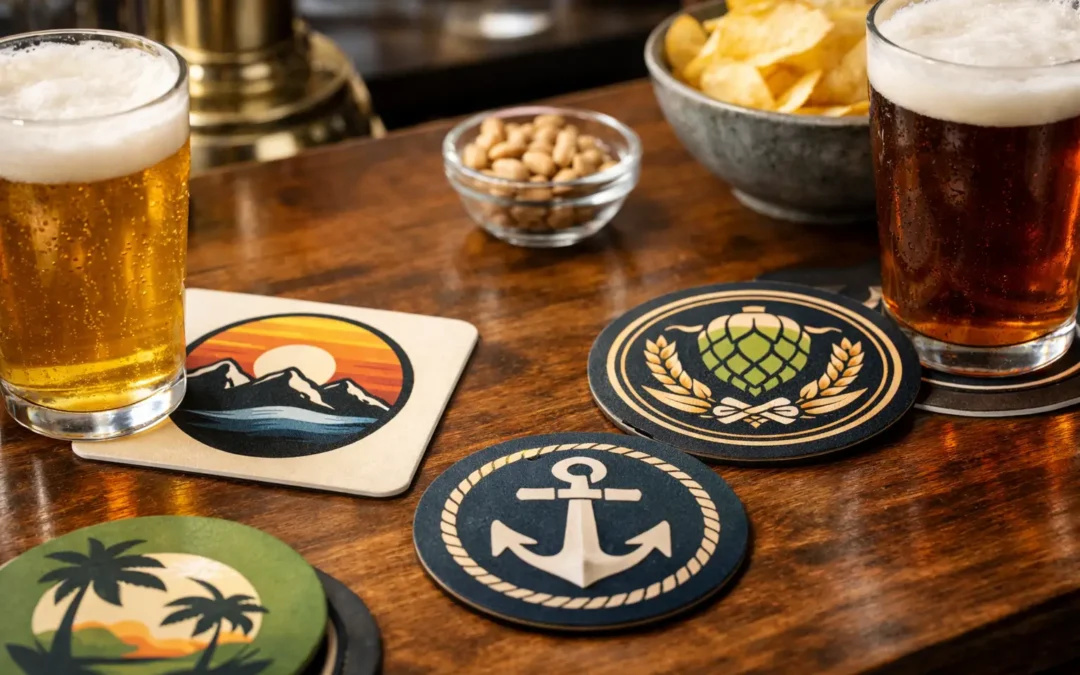
Cardboard beer coasters are a practical choice for high-volume service. They are absorbent, familiar to customers and well suited to bold, full-colour branding. They can also be printed on both sides, giving you room for a logo on one side and a promotion, event listing or venue message on the other.
Reusable materials suit venues where presentation and longevity matter more than the lowest unit cost. Cork brings a natural, relaxed look and works well for breweries, wine bars and venues with a sustainable design direction. Acrylic, aluminium, stainless steel and glass can create a sharper, more premium impression, but they need to suit the surface and service conditions. A coaster that slides too easily, shows water marks or is expensive to replace may not be the right fit for a packed Saturday night.
The strongest option is not always the most expensive material. It is the one that performs consistently in your venue and supports the brand experience you want customers to remember.
Build a design people can recognise at a glance
Coasters are viewed close up, often under low lighting and alongside menus, receipts, mobiles and glassware. Small details can disappear quickly. Keep the key branding simple, clear and easy to identify from a short distance.
Your venue name or logo should be the primary element. If your logo includes fine lines, intricate illustrations or small type, it may need a simplified coaster version. This is common and does not weaken your identity. In fact, adapting artwork to the product usually makes the finished result look more professional.
Use your established brand colours where possible, but allow for the material beneath the print. Uncoated cardboard, cork and bamboo have their own natural tone and texture, which can alter the appearance of lighter colours. Dark artwork with strong contrast often works best on absorbent board, while a crisp white background may need a suitable print treatment to hold its impact.
A useful rule is to give each side one clear purpose. The front can carry your logo, venue name and a simple graphic. The reverse can include a weekly special, trivia night, function space message, social handle, responsible service reminder or a QR code. Do not try to fit every menu category and promotional message onto one coaster. Customers should understand it in seconds, not study it like a flyer.
Choose a shape that supports your brand
Round coasters are a classic pub choice because they suit most glasses and feel familiar in service. Square coasters offer a little more usable space for artwork and can give a more contemporary result. Custom shapes can be memorable, especially for a brewery, sports club or themed venue, but they should still sit flat, stack easily and work with the glasses you serve.
Consider the practical details before committing to an unusual shape. Complex cut-outs can affect cost, production time and packing efficiency. They may also create areas that bend or wear faster in a high-use environment. For most venues, a standard round or square format with distinctive artwork delivers better value than a novelty shape with limited branding space.
Prepare artwork for a clean production result
Good artwork prevents delays and avoids surprises at proof stage. Ideally, provide your logo as a vector file, such as AI, EPS or print-ready PDF, so it can be scaled without losing sharpness. High-resolution PNG files can work for some designs, but a small image pulled from a website is unlikely to produce the finish you want.
Make sure the artwork includes adequate bleed around the edge where required. Keep important text, logos and borders away from the trim line, as minor movement during cutting is normal in print production. Thin borders can look uneven if they sit too close to the edge, so a full-bleed colour or a more generous margin is usually safer.
If you are adding a QR code, test it before approving production. It needs enough clear space around it, strong contrast and a size that can still scan after the coaster is printed. A code that looks neat on screen but fails under pub lighting is wasted space.
A Free Digital Proof is particularly valuable at this stage. It lets you check spelling, colours, layout, logo placement and any event details before the order moves into production. Approval should involve the person responsible for the brand as well as the person who understands venue operations. Both perspectives matter.
Plan quantities around real venue use
Coaster quantities are often underestimated because they are treated as a one-off promotional item. In a pub, they are part of daily service. Think about your average covers, table turnover, weekends, functions and outdoor areas. A coaster may be used once, especially when it becomes damp, marked or taken home by a customer.
Ordering a larger quantity can reduce the cost per coaster, but only if the design will remain current. If you regularly change your menu, seasonal campaign or event programme, a smaller run may be more sensible. Keep the core venue branding on the main order and use shorter promotional runs for time-sensitive messages.
For groups with multiple venues, decide whether the coasters should carry a shared group identity, individual venue branding or a combination of both. A common logo on one side and venue-specific details on the reverse can provide consistency without making every location feel the same.
Use both sides without making the coaster busy
Double-sided printing is one of the easiest ways to gain more value from branded pub coasters. The important point is to make each side useful. A venue logo on both sides may be appropriate for simple brand reinforcement, but there is often an opportunity to do more.
One side could promote a signature menu item or house beer. The other could point customers towards upcoming live music, a members programme, a function enquiry message or a responsible drinking notice. Sports clubs may use the reverse for fixture information or sponsor recognition. Event venues can use coasters as part of the event styling, with a date, monogram or welcome message that guests may take home.
The message should suit the likely life of the coaster. If it will be used for months, avoid a short-term offer that becomes outdated. If it is for a single festival, launch or fundraiser, make the event feel deliberate and collectable.
Balance finish, budget and turnaround
Material, print coverage, shape, quantity and finishing all affect price and production timing. A simple, standard-size cardboard coaster with clear artwork is generally the most efficient route for a large venue order. Specialty materials and custom shapes can elevate the result, but they may need more lead time and a higher budget.
It pays to share your deadline early, particularly if the coasters are needed for a reopening, sponsorship activation, wedding reception, major sporting event or Christmas function. Allow time for artwork preparation, the digital proof process, production and delivery. Rushing the order can limit material options or reduce the time available to check details properly.
An experienced supplier should be able to discuss the trade-offs clearly rather than steering every customer towards the same product. Drink Coaster offers a broad material range, tailored quoting and design support, helping venues select a coaster that matches both the intended use and the available budget.
Make coasters part of the venue experience
A branded coaster works best when it belongs to a wider presentation standard. Match its colour and style to your menus, signage, loyalty cards, uniforms or table numbers. If your venue has a strong local story, include a subtle reference to the neighbourhood, building, brewery or club history. These details give customers a reason to notice the coaster rather than seeing it as disposable print.
Ask bar staff for feedback after the first order has been in use for a few weeks. They will quickly tell you whether the material absorbs well, stays in place, handles condensation and is easy to stock behind the bar. That practical feedback is often more useful than judging the product from a digital mock-up alone.
A good pub coaster is a small but hardworking piece of branding. Choose it with the same care you would give to a menu or sign, and it can protect your tables while keeping your venue firmly in customers’ minds.