A busy trade show floor gives visitors hundreds of reasons to walk past a stand. Coasters for trade shows give them a practical reason to stop, pick something up and take your brand with them. Unlike a brochure that may be filed away or discarded, a well-made coaster can move from the event to an office desk, meeting room, staff kitchen or home bar.
For exhibitors, the value is in that repeat visibility. Every coffee, water bottle or after-work drink becomes another moment where the logo, message or campaign artwork is seen. The right coaster also adds polish to the stand itself, especially where coffee meetings, product demonstrations or hospitality form part of the visitor experience.
Why coasters work on a trade show stand
Promotional products need to earn their place in an event budget. They should be useful, easy to carry and clearly connected to the business presenting them. A coaster meets all three requirements. It is lightweight, compact and suitable for almost every industry, from hospitality and property to technology, finance, construction and professional services.
They are also easy to distribute without creating clutter. A stack placed beside a coffee station, a meeting table or a product display looks intentional rather than promotional. Visitors can take one without needing to commit to a lengthy conversation, while your sales team can use the coaster as a natural opening: “Would you like one for your desk?”
For brands serving venues, clubs, cafés or beverage businesses, the fit is even stronger. A custom coaster shows the product in its intended setting. It demonstrates attention to presentation while giving prospects a physical sample of what branded tabletop merchandise can achieve.
Choosing coasters for trade shows by material
The best material depends on what the coaster needs to do after the show. A high-volume giveaway has different requirements from a premium item reserved for booked appointments, VIP guests or key account conversations.
Cardboard for broad event distribution
Printed cardboard coasters are a practical choice when quantity matters. They are lightweight, economical and offer a generous print area for logos, product imagery, campaign lines, QR codes or event-specific messaging. For a two-day exhibition with steady foot traffic, cardboard allows businesses to prepare enough stock without putting unnecessary pressure on the budget.
They are particularly effective for coffee carts, hospitality activations and stands with casual conversations. If the artwork is strong, a simple cardboard coaster can be memorable without being expensive. The trade-off is longevity: it is designed as a promotional giveaway rather than a long-term desk accessory.
Cork, bamboo and leather for a considered finish
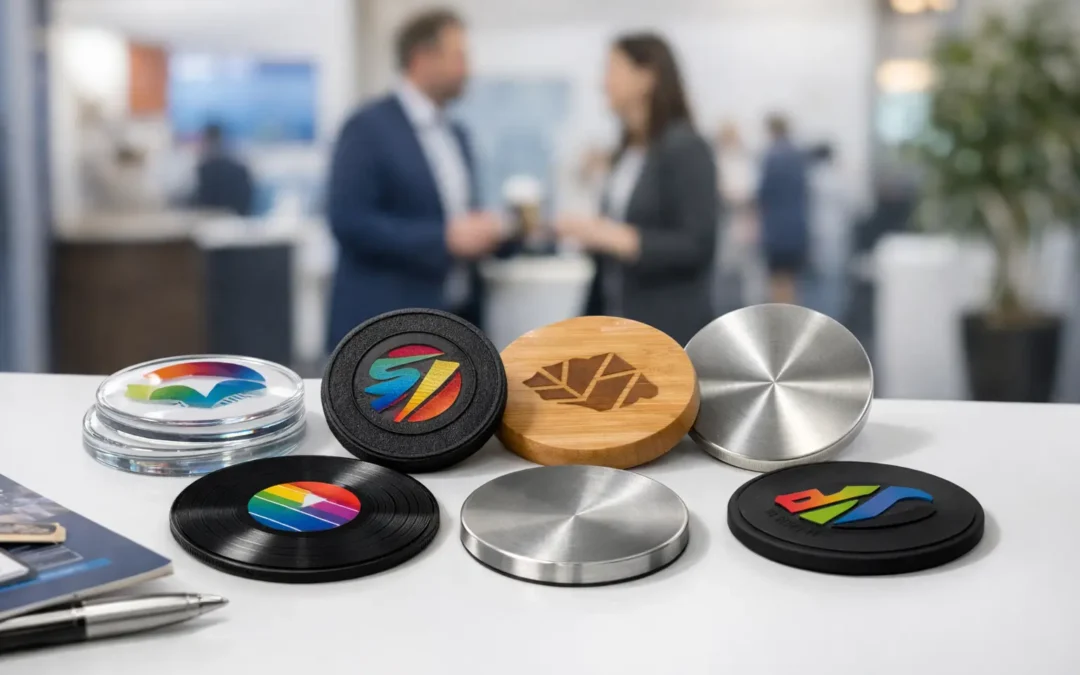
Natural materials suit brands that want a warmer, more premium look. Cork and bamboo are popular where sustainability messaging, wellness, food and beverage, property or lifestyle branding are part of the presentation. Their texture creates a point of difference from standard printed paper items and can complement a stand built with timber, greenery or natural finishes.
Leather-style coasters offer a more corporate, refined feel. They work well for executive meetings, client lounges, conference sponsorships and premium gift packs. These materials generally carry a higher unit cost, so they are best used selectively when the perceived value supports the investment.
Acrylic, metal, glass and resin for premium campaigns
Acrylic, stainless steel, aluminium, glass and resin coasters can turn a giveaway into a keepsake. They are suited to launches, milestone events, high-value lead generation and brands that need a product with substantial visual impact. Clear acrylic can suit modern technology or design-led businesses, while metal can give industrial, automotive or engineering brands a confident finish.
Because these options are durable and more substantial, they are ideal for smaller quantities or targeted distribution. A premium coaster handed to a qualified prospect after a meaningful conversation can make more sense than offering the same item to every passer-by.
PVC rubber and LED options for attention
PVC rubber is flexible, durable and well suited to bold shapes, raised details and bright colours. It works for brands with recognisable icons, mascots or product forms. LED coasters can create an immediate visual feature at a bar activation, evening function or launch event where lighting and atmosphere matter.
These options are not necessary for every stand. If the event is formal or the brand relies on understated presentation, a subtle material may be more appropriate. But where stopping power is the goal, an unusual coaster can help a stand feel more distinctive.
Match the coaster to the visitor journey
The most effective promotional item has a clear job. Before choosing a material or print finish, decide how visitors will receive and use the coaster.
For walk-up traffic, make collection easy. Place coasters in neat stacks where people can see the artwork from a distance, and avoid designs that only make sense when explained. A clear logo, short message and strong brand colour are usually more effective than a crowded layout.
For scheduled meetings, use the coaster as part of the table setting. Place one at each seat with water, coffee or refreshments. This makes the discussion feel prepared and professional, while putting your branding in front of attendees for the full conversation.
For lead generation, a coaster can support an offer without becoming an advertisement overload. Include a concise call to action, such as a service benefit, event competition prompt or product launch message. If a QR code is used, ensure it is large enough to scan quickly and leads to a mobile-friendly page. It should add value, not replace the core branding.
Artwork that reads in a few seconds
Trade show visitors make quick decisions. Your coaster artwork should work at arm’s length and in a busy environment. Start with the logo, then choose one supporting message. A business name, service category and one memorable line will often outperform a design crowded with phone numbers, product lists and fine print.
Contrast matters. Light text on a light background may look elegant on screen but disappear under exhibition lighting. Likewise, very thin lines and intricate details can lose clarity depending on the print method and material. Keep the design purposeful, with enough clear space around the main elements.
A double-sided coaster gives more room where needed. One side can carry the brand identity, while the reverse can feature a campaign, offer, product image or QR code. However, a two-sided design is only worthwhile if both sides have a role. If the coaster will sit on a table for most of its life, the upper-facing side needs to carry the key message.
Free digital proofs are valuable at this stage. They allow the artwork, sizing and placement to be checked before production, reducing the risk of a logo appearing too small or critical details sitting too close to the edge.
Plan quantities, timing and budget early
Exhibition quantities are rarely based on attendee numbers alone. Not every attendee will visit your stand, and not every visitor should receive the same item. Consider the expected foot traffic, number of show days, staff capacity to engage people and whether coasters will also be used at meetings or included in post-event packs.
A practical approach is to separate stock into two groups: a larger quantity for general visitors and a smaller premium run for qualified leads, clients or event partners. This can give your team flexibility without requiring every giveaway to carry a premium price tag.
Allow enough production time for artwork approval, manufacturing and delivery to your location. Leaving promotional merchandise until the final week creates avoidable pressure, particularly when a specific material, custom shape or detailed branding treatment is required. Ordering early also gives the team time to inspect the finished product and pack it with the rest of the exhibition materials.
Make the coaster part of the stand, not an afterthought
Coasters perform best when they are integrated into the experience. Use them beneath drinks, at consultation tables, in welcome packs or alongside a small hospitality offering. A coaster sitting under a freshly made coffee is more likely to be noticed and kept than one buried in a bag of mixed giveaways.
For event organisers and sponsors, they can also carry table numbers, session information, venue branding or a sponsor message. This is useful at conferences, networking functions and gala dinners where every setting creates a branding opportunity.
Drink Coaster helps Australian businesses, venues and event teams select materials and branding treatments that suit their goals, from economical cardboard runs to premium custom options. The most useful starting point is a clear brief: who should receive the coaster, where it will be used and what you want them to remember.
A well-chosen coaster will not replace a strong stand, capable staff or a clear offer. It can, however, give the right conversation a useful and lasting place to land.